
How a Motorcycle Should Be Towed: A Lake Mary Rider's Guide
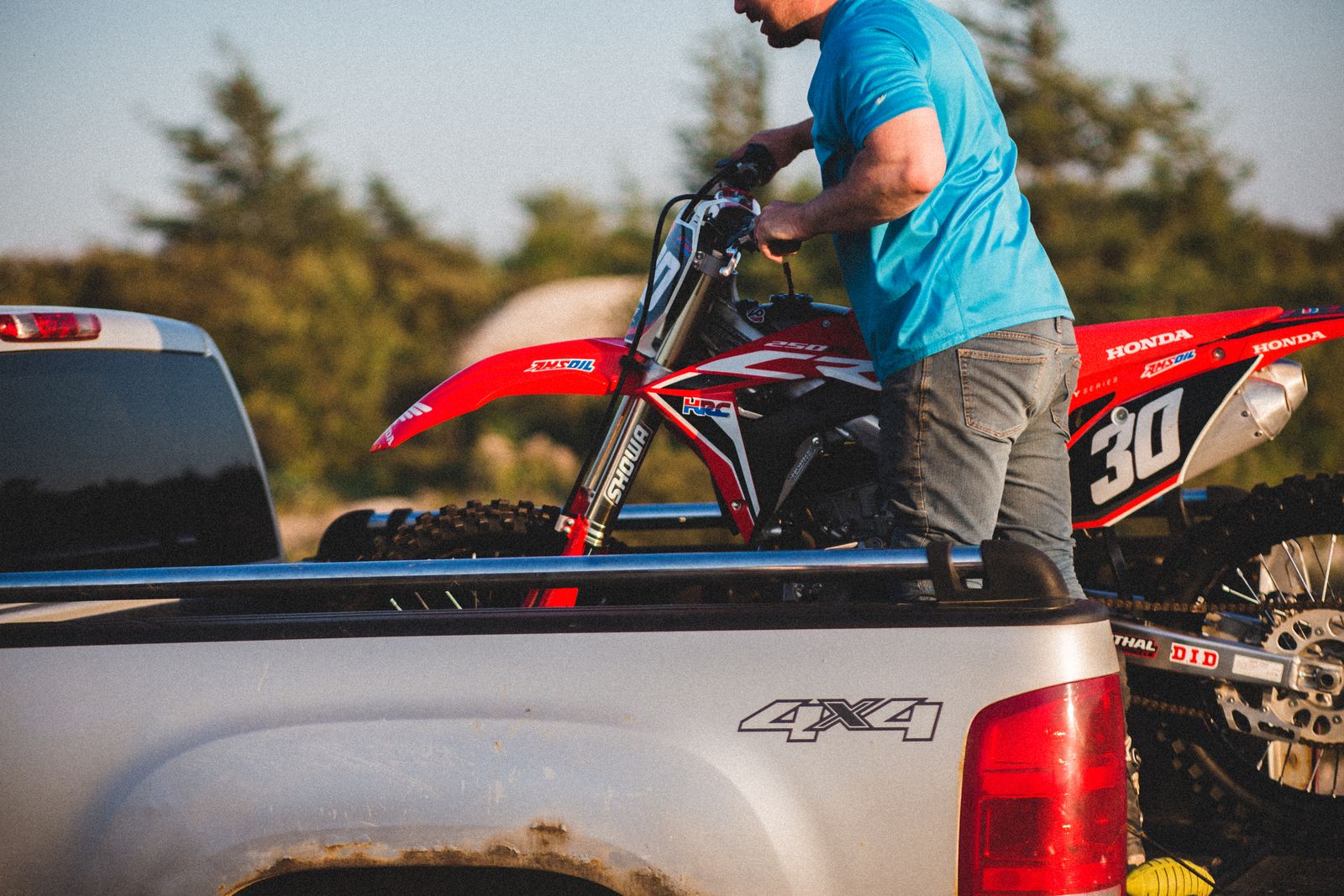
A bike that quits on the shoulder of Lake Mary Boulevard is a different problem from a car that quits in the same spot. There is no cabin to sit in and nothing holding the machine upright once you step away from it. How a motorcycle should be towed comes down to one idea: every contact point stays supported and still, from the moment the bike leaves the pavement until it is back on level ground. Get that wrong and the repair bill outruns the tow bill. Here is what a correct motorcycle tow looks like around Seminole County, and what to check before anyone touches a strap.
- A motorcycle belongs on a flatbed deck, not hoisted by one end behind a wheel-lift truck.
- Soft loops and motorcycle-specific straps go on the fork legs and lower triple clamp, never over brake lines or painted bodywork.
- Harley-Davidson's loading guidance calls for at least three straps and front suspension compressed about one inch.
- A chock on the deck does most of the work; straps hold the bike in it rather than holding it up.
- Florida allows a disabled vehicle on the shoulder of a limited-access road like I-4 for up to six hours, but it is no place to wait.
- Florida's private-property towing law treats a motorcycle as a vehicle, so signage and release rules apply to your bike.
A Flatbed Is the Only Towing Method That Suits a Motorcycle
A motorcycle should be towed on a flatbed, with the whole machine on the deck and nothing touching the road. Every other method in a tow operator's kit was engineered around a car. A wheel-lift cradles two tires and leans on a car's suspension geometry and frame rails; a bike has neither. A tow dolly leaves one wheel spinning on asphalt the entire trip, which on a chain- or shaft-drive bike means the drivetrain turns with no oil pressure behind it.
The deeper issue is balance. A motorcycle has a contact patch the size of a hand and falls the instant it stops being held. On a flatbed it never balances itself at all: it sits in a chock on a flat surface, strapped to that surface, and deck and bike move together over every expansion joint on I-4. A dispatcher who hears the word motorcycle should be sending a rollback, and our flatbed towing trucks carry a deck-level chock for exactly that reason.
Soft Straps and Correct Tie-Down Points Do the Real Work
Soft straps matter because a bare metal hook dragged across a fork leg, or a ratchet strap pulled tight over painted bodywork, will mark, crush, or snap whatever it touches. A soft loop is a short fabric sleeve that wraps the hard point and gives the hook something to grab that is not your motorcycle.
Where the straps land matters as much as what they are made of. Harley-Davidson's guidance on loading a motorcycle calls for ratcheting or cam-buckle straps built for motorcycles, at least three of them, and for bikes with fairings it specifies running the straps around the fork legs and the lower triple clamp. Those parts are structural. Handlebars, mirrors, signal stalks, and brake lines are not, and a strap routed over a cable or a sharp edge will pinch the cable or saw through itself.
The same guidance settles how tight is tight enough: tighten until the front suspension compresses about one inch. That is enough preload to keep the bike from bouncing out of the chock without parking the fork seals at full stroke. A motorcycle should also never travel on its center stand, because if the stand folds or skips on a bump the bike is suddenly loose on a moving deck.
A Correct Load-Up Runs in the Same Order Every Time
Loading a motorcycle is a sequence, not a scramble. The deck comes down and tilts first, because ramp angle is the quiet hazard: Harley-Davidson's guide warns that a steep angle risks the bike high-centering on its frame or side stand partway up, and a rollback that sets its deck nearly flat removes it.
The bike then goes up under control, walked by one person with a second steadying it, or winched if the engine is dead. The front wheel seats into the chock, and that is the moment it stops needing a human to stay upright. Front straps go on first, pulling forward and slightly outward from the fork legs so the bike presses into the chock instead of being dragged sideways out of it.
The rear is secured last, to the frame or the passenger footpeg mounts, so the back cannot walk under braking. A good operator rocks the bike by hand to feel for movement, then rechecks the straps a few minutes into the drive, because webbing settles and a strap that was snug in the parking lot is often loose by the on-ramp.
Bike down between Lake Mary and Sanford? Ask for a flatbed with a chock and soft straps on board.
Contact Lake Mary TowingWhere the Bike Stopped in Lake Mary Changes the Plan
Location decides how fast a bike has to come off the road, and Lake Mary offers several versions of the problem. On I-4 between the Lake Mary Boulevard exit and the State Road 417 interchange the shoulder is narrow and traffic is quick enough that standing beside a stopped motorcycle is dangerous. NHTSA reports that per mile traveled, motorcyclists are roughly 27 times more likely than passenger-car occupants to die in a crash.
Florida law gives you a window, not a comfortable one. Under Florida Statute 316.1945, stopping on the roadway or shoulder of a limited-access facility is prohibited, with an exception for disabled vehicles for up to six hours. That is a ceiling, not a recommendation, and says nothing about where the rider stands. Get well off the pavement and let the bike sit.
Surface streets fail differently. Rinehart Road, Markham Woods Road, and Lake Mary Boulevard east of downtown have soft sand-and-grass shoulders that swallow a side stand, and a bike left on a hot afternoon can be leaning badly by the time help arrives. A kickstand puck or anything that spreads the load keeps it upright. Central Florida's summer storm pattern supplies the rest: a bike that stalls at four in the afternoon in July is often standing in water within the hour.
Florida's Towing Rules Count Your Motorcycle as a Vehicle
A motorcycle gets the same legal protections as a car when it is towed from private property in Florida. Florida Statute 715.07 defines a vehicle as any mobile item that normally uses wheels, motorized or not, so a bike parked outside an office building on Primera Boulevard or at an apartment complex off Rinehart Road sits squarely inside the statute.
The practical rules are worth memorizing. A property owner has to post tow-away signage at each driveway, with letters at least four inches high carrying the towing firm's name and current phone number. If you reach your motorcycle while it is actively being hooked and ask for it back, the operator has to stop and release it for no more than half the posted rate. Once it has gone to a storage lot it must be released within one hour of a request, and no one can require a liability waiver as a condition of release.
What the Dispatcher Needs to Hear to Send the Right Truck
The fastest motorcycle tow starts with a specific phone call, because the answers decide which truck leaves the yard. Lead with the fact that it is a motorcycle, then the size class: a dressed touring bike near 900 pounds needs a different plan from a 350-pound standard, and a trike or sidecar rig will not fit a single chock at all.
Say whether the bike rolls and steers. One that rolls freely can be walked up a ramp in two minutes; a seized engine, a flat tire, or a bent fork calls for a winch and sometimes a skate, which is better known before the truck arrives than after. If the bike has been down, say so, along with any fuel or oil on the ground.
Then give a location someone can drive to: on the interstate, the nearest mile marker and direction of travel beat a street name. Finally, say where the bike is going, because a dealer bay, a home garage with a narrow approach, and a storage unit are three different unloading problems. Our roadside assistance dispatchers ask anyway, but volunteering it shortens the call.
What Riders Should Nail Down Before the Truck Arrives
The decision that matters most happens before anything moves: confirm a flatbed is coming, and that the crew carries soft straps and a chock. Those two answers predict how your bike arrives better than any price quote does, because most towing-related motorcycle damage traces back to the wrong equipment, not the wrong driver.
The rider's own job is small but real: get off the pavement, put something solid under the side stand, note your mile marker or cross street, and leave the bike in neutral with the steering unlocked so it can be rolled and chocked easily.
When a bike goes down on I-4 or refuses to start outside a Rinehart Road office park, that is the moment to ask for a deck. Lake Mary Towing runs flatbed towing built for this kind of load, and the same crews handle roadside assistance when a jump, a tire, or fuel is all the bike needs.