
Can You Tow an Electric Car? A Lake Mary Guide to Flatbeds, Tow Eyes and Dead 12-Volts
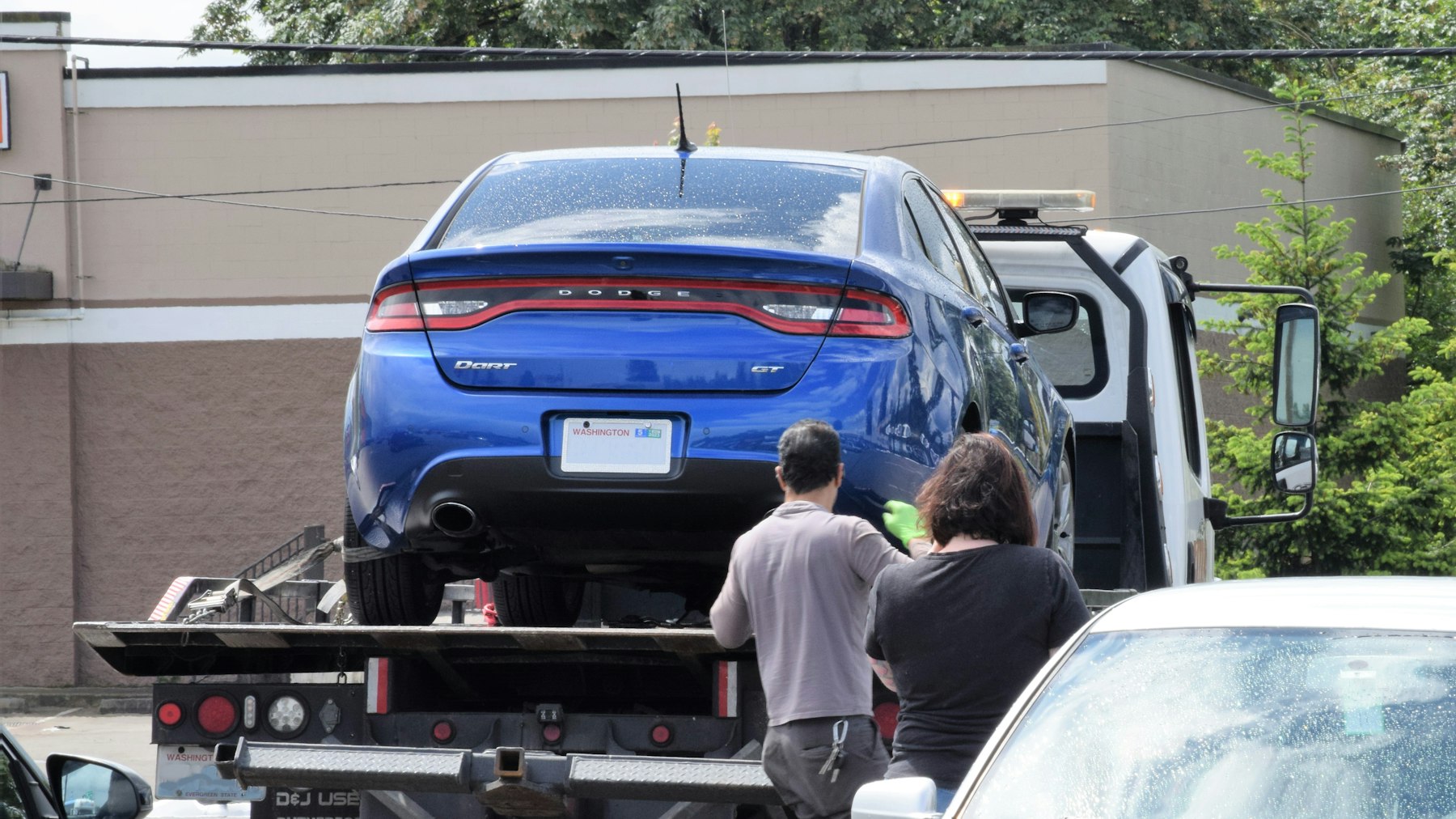
A Model Y sits dead in the Colonial Town Park lot, the shifter refuses to leave Park, and the driver has already tried shoving it by hand. So: can you tow an electric car? Yes, and it happens every day. The honest part is that almost everything an operator does with a gas car changes once the badge says EV. There is no gearbox to drop into neutral, the battery that unlocks the doors is not the battery that moves the car, and the points a strap may touch are printed in the owner's manual rather than guessed at.
An Electric Car Can Be Towed, but Almost Always on a Flatbed
An electric car can be towed, and in nearly every case it belongs on a flatbed with all four wheels off the ground. That is not a tow company preference. It is what the manufacturers write themselves: Tesla's instructions for transporters say to always transport the car with all four tires off the ground, because the motors generate current whenever the wheels spin and a freewheeling axle can overheat the drivetrain.
The reason is structural rather than electrical. In a gas car the engine and the wheels separate when the transmission goes to neutral, which is the whole premise of a wheel-lift tow. An electric motor is usually bolted to the axle through a single fixed-ratio reduction gear, permanently engaged, with no neutral to select. Roll the wheels and you turn the motor; turn the motor and you are running it as a generator into a pack that may be in no condition to take the current.
Dollies have not vanished from the answer. They are what a crew reaches for when a deck cannot be used, and Tesla permits a dolly setup provided every wheel is off the ground, capped at 35 miles. Around here that usually means a parking garage with low clearance, or a driveway too tight for a rollback. Lake Mary Towing runs flatbed towing for everything else.
There Is No Mechanical Neutral to Put an EV In
Neutral in an electric car is a software state, not a lever. Selecting it asks the vehicle's computers to release the parking pawl and the electric parking brake, so it only works while the low-voltage system is awake and a key is detected. Lose either and the car stays locked in Park no matter what the driver does with the shifter.
Manufacturers build a deliberately narrow exception for this moment. Tesla describes Tow Mode as only intended to allow for winching the car onto a flatbed truck, holding it under 5 mph for less than 30 feet. That is a loading aid, not a way to roll the car down the block, and going past those limits turns a ten-minute hookup into a drivetrain invoice.
The width of that window decides how the job goes. An operator who can wake the car has a straightforward winch up the deck; one who cannot has to work skates under wheels that will not turn. It is why the first question a dispatcher asks about an EV is usually whether it still powers up.
A Dead 12-Volt Battery Is What Really Strands an EV
Most electric cars that will not move are not out of charge. They have a dead 12-volt battery. Every EV carries an ordinary low-voltage battery alongside the high-voltage pack, and it is the small one that runs the latches, the touchscreen, the shifter logic, and the contactors that connect the big pack to anything.
The symptoms are specific enough to recognise before you call. The doors do not unlock from the handle or the phone app. The screen stays black. The charge port will not release. On several models the front trunk latch is electric too, which matters because the front trunk is where the tow eye lives.
Tesla's transporter instructions address this directly: with no low-voltage power, the hood has to be opened and the 12-volt battery jump-started from an external supply before the touchscreen, and therefore Tow Mode, becomes available at all. Without that, the car gets loaded on skates or dollies. A roadside assistance call that brings a low-voltage jump sometimes ends the whole problem in the parking lot.
Sitting with an EV that will not shift out of Park somewhere between Heathrow and Lake Mary Boulevard? Give us the make and model when you call, so the truck leaves with the right deck and skates already aboard.
Contact Lake Mary TowingThe Tow Eye and the Tie-Down Points Are Not Where You Think
On an electric car the winch cable hooks to a threaded tow eye, not to a control arm or a convenient bit of subframe, and the difference is a battery enclosure. The pack is a structural floor panel running most of the wheelbase, so the improvised hook points under a gas car are either gone or sitting against high-voltage hardware.
Tesla stores a screw-in tow eye in the front trunk and says to only pull the vehicle onto a flatbed truck using a properly installed tow eye, warning against the chassis, the frame and the suspension. Where no eye is fitted, straps belong on the lower suspension arms and nowhere else, and tie-downs follow a separate eight-point map of their own.
Federal guidance says the same in a model-agnostic way. NHTSA's interim guidance for towing and recovery operators tells crews to refer to the vehicle manual or recovery guide for the proper attachment points and transport method, and to stay clear of the orange high-voltage cabling and anything wearing a high-voltage warning label.
A Damaged High-Voltage Battery Changes the Whole Call
A wrecked or flooded EV is treated as a live hazard until a manufacturer says otherwise, and that turns a transport job into a managed one. NHTSA's guidance is blunt: assume the high-voltage battery is energised and fully charged, approach from the sides to stay out of the vehicle's potential travel path, and keep at least 16 feet away until it is loaded.
The warning signs are sensory rather than technical, which helps a driver standing beside the car. Leaking fluids, sparks, smoke, flames, a rising temperature, or gurgling, popping and hissing from the battery compartment all mean call 911 rather than wait for a hook. Damaged lithium-ion packs can also reignite long afterwards, which is why the same guidance says not to store a severely damaged EV inside a structure or within 50 feet of buildings, other vehicles or anything combustible.
Model-specific instructions exist for exactly this. The U.S. Fire Administration points responders at manufacturer emergency response guides, free to download and collected by the National Fire Protection Association for more than 35 alternative-fuel manufacturers. For a driver the practical version is one sentence: if the car has been in a crash or sat in standing water, say so on the phone.
Where You Stop in Seminole County Changes the Hookup
Where the car stops decides how much room the crew has, and an EV needs more of it than a gas car does. A flatbed has to get square to the vehicle and lower a deck behind it; skates and dollies need level, firm ground at all four corners, not three. These are not unusual calls any more, either: the U.S. Department of Energy counted 254,878 registered all-electric vehicles in Florida at the end of 2023, second only to California.
The easy version is a lot. Colonial Town Park, the retail strip along Lake Mary Boulevard, and the office campuses off International Parkway in Heathrow all have space to lower a deck with no traffic behind the operator. Parking garages are the awkward middle: low clearance rules out a rollback and forces the dolly route.
The hard version is a limited-access shoulder. I-4 runs along the west side of Lake Mary and the Seminole Expressway leg of State Road 417 passes to the east, where Florida's Turnpike Enterprise, the agency that operates that stretch, lists Lake Mary Boulevard as Exit 49. Neither road offers a shoulder wide enough to set dollies comfortably, so an EV recovered from one is winched onto a deck in Tow Mode when the car cooperates and dragged on skates when it does not.
What Lake Mary EV Owners Ask About Getting Towed
Can an electric car be flat-towed behind an RV?
Almost never, and any exception has to come from your own owner's manual rather than a general rule. Most EVs have no neutral that disconnects the motor from the wheels, so towing with the drive wheels rolling spins the motor and risks the drivetrain. A handful of models publish a flat-tow procedure; the rest do not.
Will a wheel-lift work on an electric vehicle?
Only with dollies under the wheels that would otherwise stay down. A wheel-lift on its own leaves two tires rolling, the exact condition manufacturers warn against. Tesla permits a dolly arrangement with all four wheels off the ground for up to 35 miles, which makes it a short-hop fallback rather than the normal method.
My EV is dead and the doors will not open. Is that the main battery?
Usually that is the 12-volt battery, not the high-voltage pack. The low-voltage system runs the latches, the screen and the shifter logic, so it can fail completely while the main battery still holds most of its charge. A jump often restores enough function to open the doors and select a tow mode, which is why a roadside call is worth making first.
What should I tell dispatch when I call about an electric car?
Lead with the fact that it is electric, then the make and model, because the tow eye location and the approved transport method are model-specific. After that, say whether the car still powers up, whether the wheels turn freely, and whether it has been in a crash or sat in water. Those answers decide what the truck brings.
Sources
- NHTSA - Interim Guidance for Electric and Hybrid-Electric Vehicles Equipped With High-Voltage Batteries (Towing, Recovery and Storage)
- Tesla Owner's Manual - Instructions for Transporters
- U.S. Fire Administration - Emergency Response Guides for Electric Vehicles and Lithium-ion Batteries
- U.S. Department of Energy, Alternative Fuels Data Center - Electric Vehicle Registrations by State