
Can You Tow a Car With a Flat Tire? A Lake Mary Guide to Wheels That Won't Roll
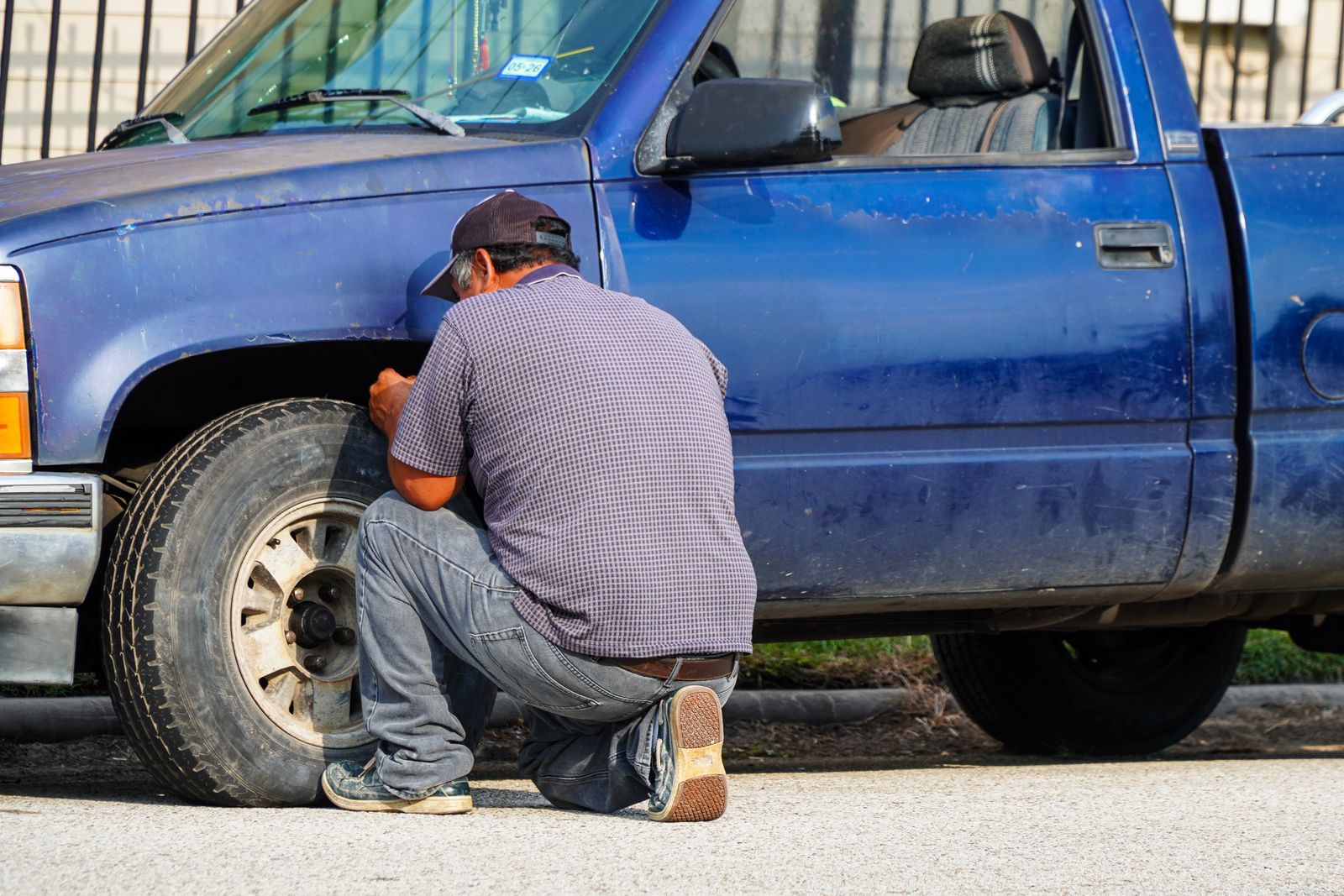
The thump starts near the Rinehart Road light and is unmistakable by the time you turn into the Colonial Town Park lot. You walk around the car and find the right rear flat on its sidewall. So: can you tow a car with a flat tire? Yes, and it is one of the most ordinary calls a tow operator takes. The more useful question is the one underneath it, because a flat tire and a wheel that refuses to roll are two different jobs, and only one of them is routine.
- A flat tire alone does not stop a tow. On a flatbed, the deflated tire never carries weight at highway speed.
- A bare rim changes the job. Dragging a tireless wheel up a steel deck gouges the rim, so operators use skates or a dolly instead.
- A wheel that will not rotate is a different call than a flat. Seized brakes, a failed bearing, or a stuck parking brake all mean the corner must be lifted, not rolled.
- A lost wheel-lock key is a tow, not a tire change. Without the keyed socket, the wheel does not come off at the roadside.
- On I-4 and the Central Florida expressway system, Florida's Road Rangers change flat tires at no cost.
Can You Tow a Car With a Flat Tire?
Yes. A flat tire is one of the least complicated reasons a car gets loaded, and on a flatbed it barely changes the procedure. The winch pulls the car up the inclined deck, the wheels are chocked and strapped, and the flat spends the trip carrying nothing.
Which truck shows up still matters, because of what a deflated tire does under load. A wheel-lift raises one axle and leaves the other two tires rolling on the pavement for the whole trip. If the flat sits on the axle left down, the rim rides on a limp sidewall at road speed, finishing off a tire that might otherwise have been repairable and chewing up the bead seat.
That is why a dispatcher who hears flat tire usually sends a deck. Lake Mary Towing's flatbed towing units handle this version with nothing extra aboard, and the flat only becomes a real problem when there is no longer a tire on the wheel.
What Changes When There Is No Tire Left on the Rim?
Once the tire has come off the wheel, the car is no longer rolling on rubber, and a routine load becomes a careful one. A bare aluminum rim dragged up a steel deck will scar, and on a soft alloy the lip can bend.
Operators handle it two ways. The first is a set of skates, low trolleys that slide under the wheel so the rim rides on wheels of its own. The second is a dolly, a two-wheel frame that cradles the rim and lets that corner be carried rather than scraped.
Either way the car moves slowly and straight, and the operator wants a flat, firm surface. A steep shoulder, or the soft sand along the edge of a Central Florida right of way, makes both tools harder to set, which is one more reason to say on the phone whether you are in a lot or on a grade.
Why Won't the Wheel Turn at All?
A wheel that will not rotate is a problem at the hub, not at the tire, and it turns the tow from a load into a lift. The usual causes are a caliper seized against the rotor, a parking brake shoe rusted to the drum, a wheel bearing that has failed and bound up, or a drivetrain locked by collision damage.
Electric parking brakes add a newer version. On a car whose 12-volt system has died, the brake can be stuck applied with no mechanical release reachable from outside. Manufacturers are explicit: the Kia owner's manual directs that all wheels be raised on a tow dolly or tire skates when the parking brake is not working, and calls for a dolly whenever a loaded wheel or suspension component is damaged.
A locked wheel cannot be winched onto a deck on its own tires, so the truck needs skates or dollies aboard. Saying the wheel does not turn, rather than the car will not move, is what gets that equipment dispatched on the first trip.
What If You Have a Spare but the Wheel Won't Come Off?
A spare in the trunk only helps if the wheel it replaces can come off, and three ordinary problems stop that at the roadside.
The first is a lost wheel-lock key. One lug on each wheel carries a keyed pattern, and the matching socket lives in the glovebox until the day it does not. Without it, that lug turns for no socket on the truck, and removal becomes a shop job with an extractor. The second is a sheared stud or a nut rounded off by an impact gun, which lands in the same place.
The third is corrosion. A wheel bonded to the hub by months of Florida humidity can refuse to drop even after every lug is off. Freeing it takes controlled strikes from behind while the car is supported, and doing that on a jack at the edge of a travel lane is how cars come off jacks. In all three cases the answer is a tow rather than a change, which is why roadside assistance crews carry both options.
Sitting on a flat somewhere between Lake Mary Boulevard and Heathrow, with no spare in the trunk or no key for the wheel locks? Ask for a unit carrying skates and a dolly, not just a jack.
Contact Lake Mary TowingIs a Roadside Tire Change the Cheaper Answer?
Often, yes, and it is worth exhausting that path before paying for transport. A tire change is a short visit with one deliverable, while a tow is a hookup plus mileage, so a car that leaves on a mounted spare usually leaves cheaper.
On the highways around Lake Mary there is also a free option drivers forget. The Florida Department of Transportation's Road Ranger patrols change flat tires at no cost, along with jump starts, emergency fuel and minor repairs; a stranded driver reaches them by dialing star 347 from a mobile phone. They work the freeways, which here means I-4 and the expressway system that State Road 417 belongs to.
Where a change stops being the answer is distance. NHTSA advises that a spare not be used as a replacement for worn tires except in emergencies such as replacing a flat, and a compact temporary spare is built for a short run to a shop, not a week of commuting down International Parkway. The agency reports that 511 people died in tire-related crashes in 2024.
Does It Matter Where in Lake Mary You Get the Flat?
Where the car stops changes the urgency and the hookup. A flat in a parking lot is a scheduling question. A flat on a shoulder is a safety question first.
The parking-lot version is the common one here: Colonial Town Park, the retail strip along Lake Mary Boulevard, the office campuses off International Parkway in Heathrow. There is room to set a dolly, room to lower a deck, and no traffic passing behind the operator.
Shoulders are the hard version. I-4 runs along the west side of Lake Mary, and the Seminole Expressway leg of State Road 417 passes to the east with interchanges at Lake Mary Boulevard and Rinehart Road before it ends at I-4 near Sanford. Both carry high speeds past narrow shoulders. Florida law helps, but only if you give it something to work with: section 316.126 of the Florida Statutes requires approaching drivers to vacate the lane nearest a disabled vehicle displaying hazard lights, or slow 20 miles per hour below the posted limit where moving over is not safe. Hazards on, occupants out past the guardrail.
What Should You Tell the Dispatcher?
Five details decide which truck leaves the yard, and offering them up front keeps this to one visit.
Say whether the tire is flat or gone, because a bare rim calls for skates. Say whether the wheel still turns with the car in neutral, because a locked corner calls for dollies. Say whether a usable spare and the wheel-lock key are both in the car, because that is what makes a change possible. Say which wheels drive the car, since an all-wheel-drive vehicle generally belongs on a deck with every wheel off the ground. And say exactly where you are, by lot name, cross street or nearest ramp, and whether you are on a shoulder.
None of that requires mechanical knowledge. Every item is something a person beside the car can test in a minute: release the parking brake on level ground, push, and watch whether the corner rotates.
Start With Whether the Wheel Still Turns
Of everything above, one check does the most work. With the car in neutral on level ground, does that corner turn? If it does, you are in the easy half of the problem, and a spare or a flatbed settles it. If it does not, stop trying to persuade it, because most of the damage drivers pay for happens in the ten minutes spent dragging a locked wheel across asphalt. The second thing worth settling before anyone arrives is whether a change is even possible: spare present, key in hand, ground firm enough to jack.
Lake Mary Towing works both sides of that line, with roadside tire changes when the spare is there and flatbed towing when the wheel has to leave the pavement entirely.